Deadly 7.8 Magnitude Earthquake Strikes Philippines, Killing at Least 37 and Injuring Hundreds
A powerful 7.8-magnitude earthquake struck the southern Philippines on Monday morning, killing at least 37 people, injuring hundreds, and causing widespread destruction across several provinces. The deadly quake hit near Mindanao Island and triggered panic among residents as buildings collapsed, roads were damaged, and tsunami warnings were issued across parts of Asia.
According to the United States Geological Survey (USGS), the earthquake occurred at around 7:37 a.m. local time at a depth of approximately 35 kilometers. The epicenter was located off the coast near Sarangani Province, close to General Santos City, one of the largest urban centers in southern Mindanao.
Emergency officials confirmed that at least 37 people lost their lives, while nearly 500 others were injured. Authorities are still assessing the full extent of the damage, and the number of casualties could increase as rescue operations continue. Several people remain missing, while thousands of families have been displaced from their homes.
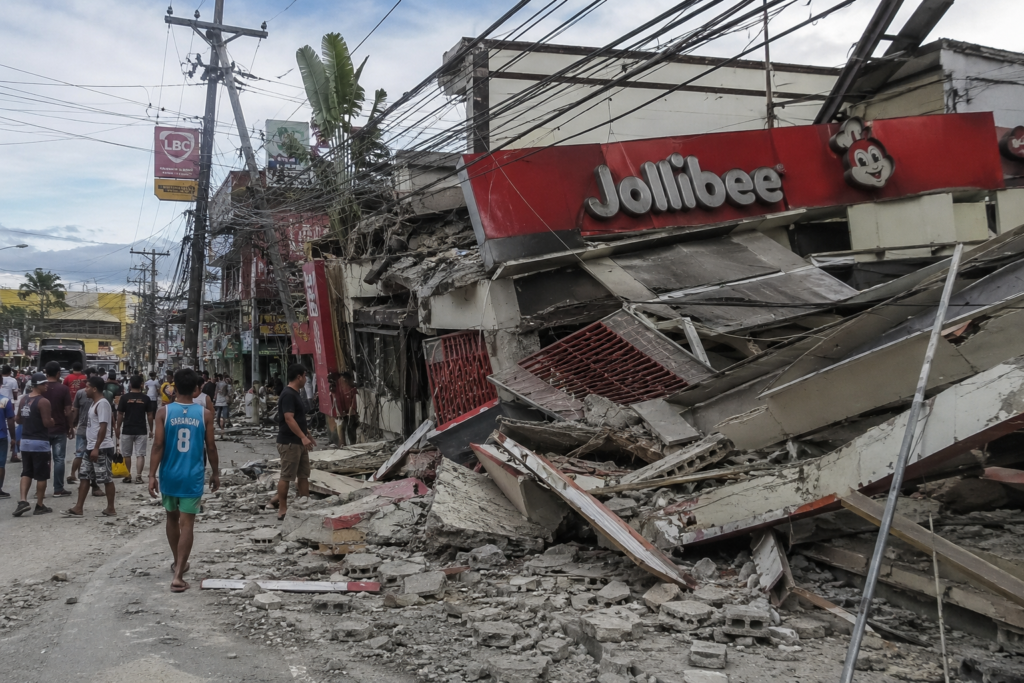
The earthquake caused severe damage to buildings, schools, hospitals, businesses, and public infrastructure. In General Santos City, parts of commercial buildings collapsed, including a popular fast-food restaurant. Hospitals reported structural damage, forcing doctors and medical staff to treat injured victims in temporary outdoor facilities.
The disaster struck on the first day of the new school year in many parts of the Philippines. Videos shared on social media showed terrified students rushing for safety as classrooms and school buildings shook violently. Some school structures partially collapsed, although many students were safely evacuated before major injuries occurred.
Following the earthquake, more than 130 aftershocks were recorded, raising fears of additional damage. Authorities warned residents to stay away from weakened buildings and remain alert for further tremors. Rescue teams, police officers, military personnel, and volunteers have been deployed to affected areas to search for survivors and provide emergency assistance.
The strong earthquake also triggered tsunami warnings in the Philippines, Indonesia, Japan, and other nearby regions. Coastal communities were advised to move to higher ground as a precaution. Fortunately, only small waves were recorded, and officials later canceled most tsunami alerts after determining that the immediate threat had passed.
Philippine President Ferdinand Marcos Jr. ordered emergency agencies to launch rescue and relief operations immediately. The government has opened evacuation centers, suspended classes in affected regions, and promised support for communities impacted by the disaster.
The Philippines is located on the Pacific Ring of Fire, one of the world’s most active earthquake zones. Because of its location, the country frequently experiences strong earthquakes and volcanic activity. However, officials described this latest earthquake as one of the strongest and most destructive to hit the country in recent years.
As rescue efforts continue, thousands of residents remain in temporary shelters while authorities assess the damage and begin recovery operations. The disaster has once again highlighted the vulnerability of the Philippines to major natural disasters and the importance of preparedness in earthquake-prone regions.